
The Science of Multi-Buy Promotions: Why the Deal Changes More Than the Price
We reviewed academic research on multi-buy promotions to understand what it can teach us about designing more effective offers. Our aim was to uncover useful findings about shopper behavior, insights that CMI, RGM, and trade marketing teams can apply as they evaluate mechanics, discount structures, and product groupings. Some of the results challenge assumptions that are easy to make when promotions are judged mainly by the price on the sign.
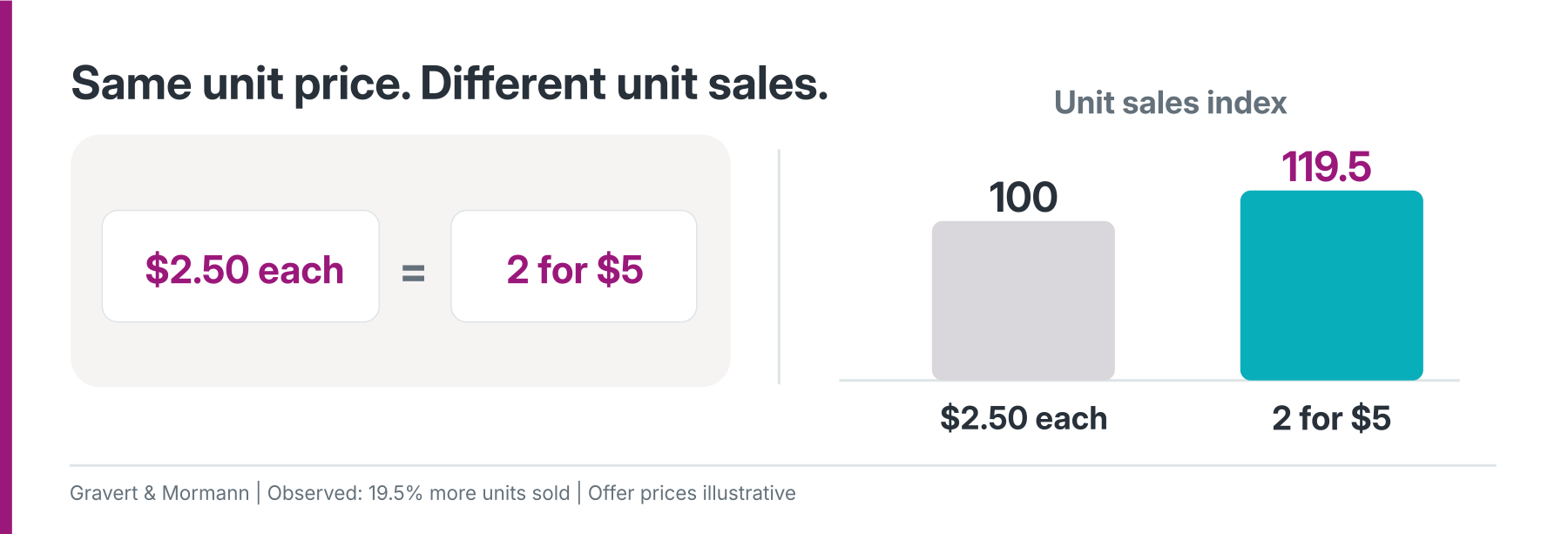
Two promotions offer shoppers exactly the same price per unit. One generates nearly 20% more unit sales.
In a field experiment spanning eight supermarkets and more than 43,000 fresh-vegetable purchases, multi-unit prices generated 19.5% more unit sales than economically equivalent single-unit discounts. The unit economics hadn't changed, but shopper response had. That raises an intriguing question: if price presentation alone can move sales, what happens when manufacturers change the qualifying quantity, how the discount is allocated, or which products are eligible?
That's what we wanted to explore: not a single winning promotion, but behavioral findings that could give manufacturers more options, and potentially better ones, to test.
1. The offer changes behavior, even when the economics don't
Consider a shelf tag reading “5 for $5.” Even if shoppers can buy a single unit for $1, the sign does more than communicate a price. It puts five units in their minds as a reasonable amount to buy.
That effect appeared in an 86-store grocery experiment: multi-unit offers produced an average sales lift of 165%, compared with 125% for economically equivalent single-unit promotions. Manning and Sprott found a related pattern in purchase-intention experiments. Larger advertised quantities prompted shoppers to consider buying more units even when there was no minimum purchase requirement and the unit price stayed the same. But the effect depended on how quickly shoppers expected to use the product. A larger quantity cue can be more persuasive for something used frequently, when buying several units feels practical. For a product purchased or consumed only occasionally, shoppers may have less reason to buy extra units.
These studies point to a useful distinction. The advertised quantity can influence purchase decisions without requiring shoppers to buy that quantity. Making the quantity mandatory creates a different behavioral problem.
2. Small changes in mechanics can produce very different responses
Increasing a multi-buy requirement from two units to four cut modeled promotional lift for a potato-chip SKU from roughly 150% to 80%. The per-unit discount hadn't changed, nor had the four eligible products. Only the number of units required to qualify increased.
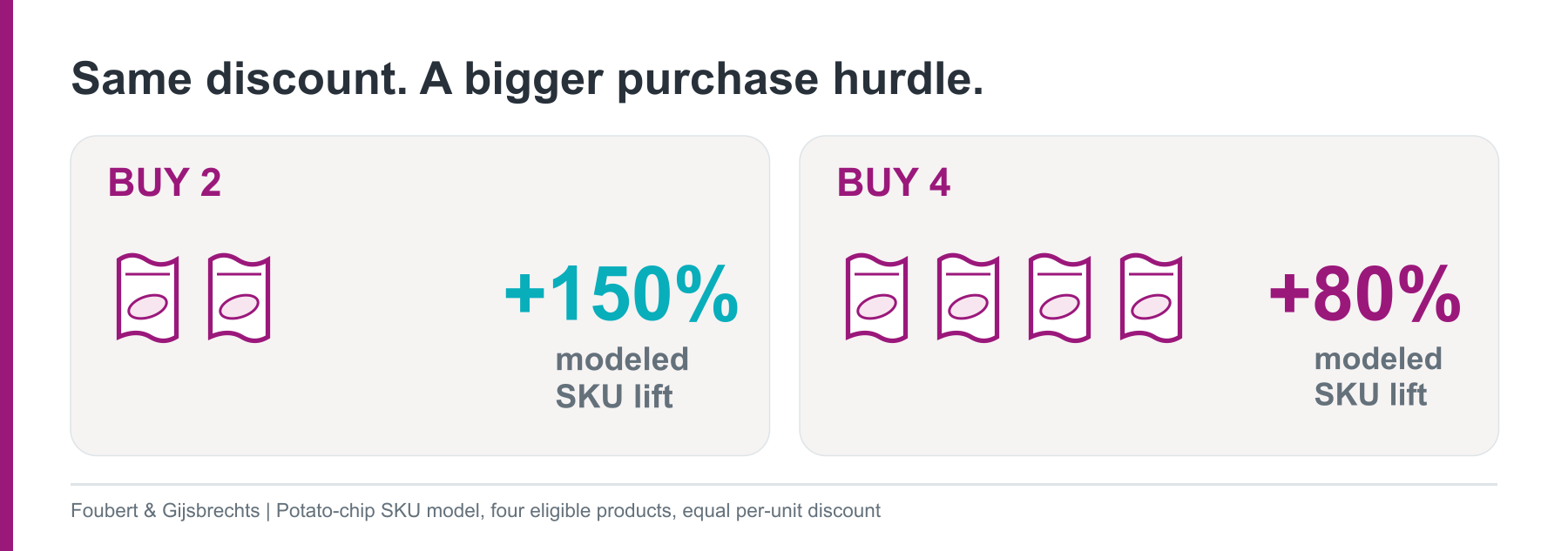
The contrast captures the trade-off identified in other multi-buy research: a higher threshold can encourage a bigger basket among shoppers who participate, while making others less likely to buy at all. More units per participating shopper don't necessarily make for a stronger promotion.
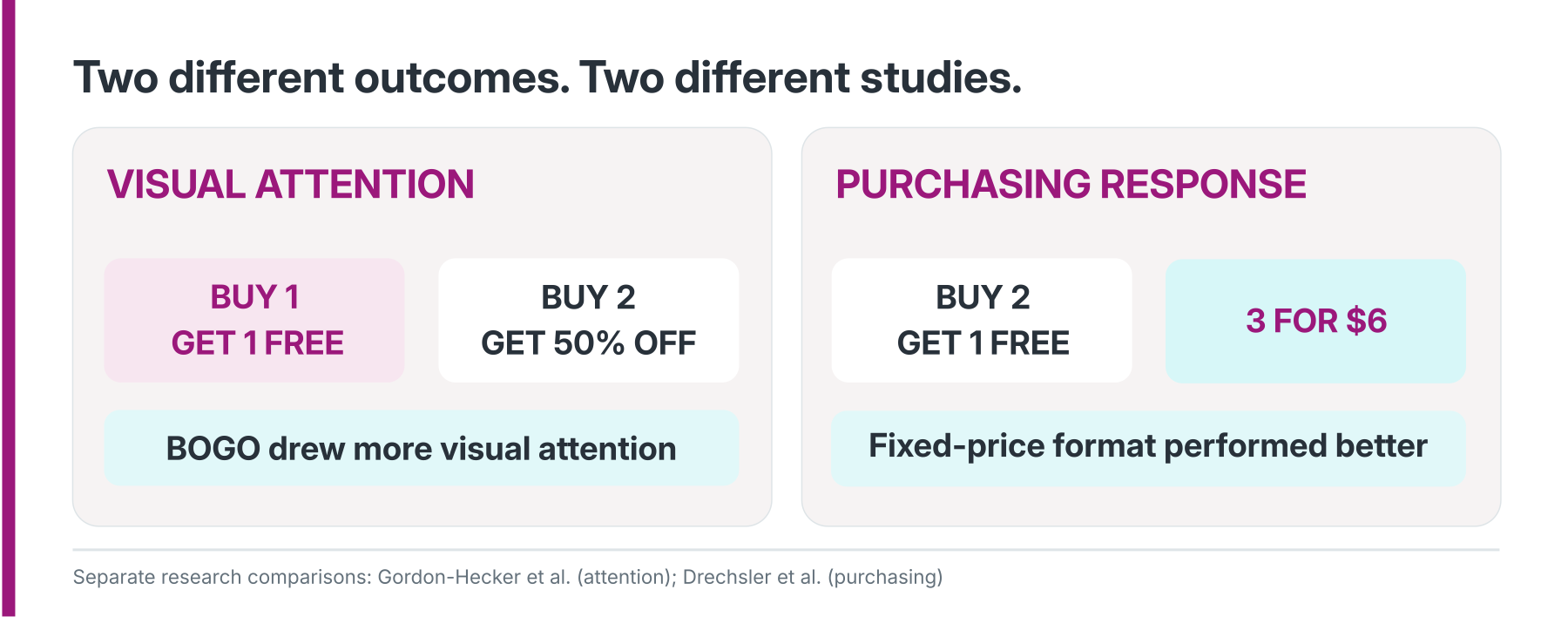
Framing the offer introduces another variable. BOGO offers have been shown to attract greater attention and preference than economically equivalent percentage discounts. In separate research, however, fixed-price multi-unit offers (X for $Y) outperformed buy-X-get-Y-free promotions on purchasing response under the conditions studied.
Consider “3 for $6” versus “buy 2, get 1 free” for a product normally priced at $3. Both give shoppers three units for $6. Yet the X-for-$Y format generated the stronger purchasing response in the relevant research, particularly for practical-use products and in some higher-quantity offers. The distinction matters: the promotion that draws the most attention is not always the one that produces the strongest sales response.
The allocation of savings can also shift behavior. Research found that concentrating a discount on one item, such as 60% off the second, could increase purchase likelihood and perceived product quality compared with spreading identical savings across two equally priced items at 30% off each.
A clothing-retail field experiment showed an even more tangible difference. Under “25% off both,” shoppers spent an average of $39 on their second item. Under “50% off the cheaper item,” they spent $65. Participation barely moved, from 38% to 39%, but the products shoppers selected did.
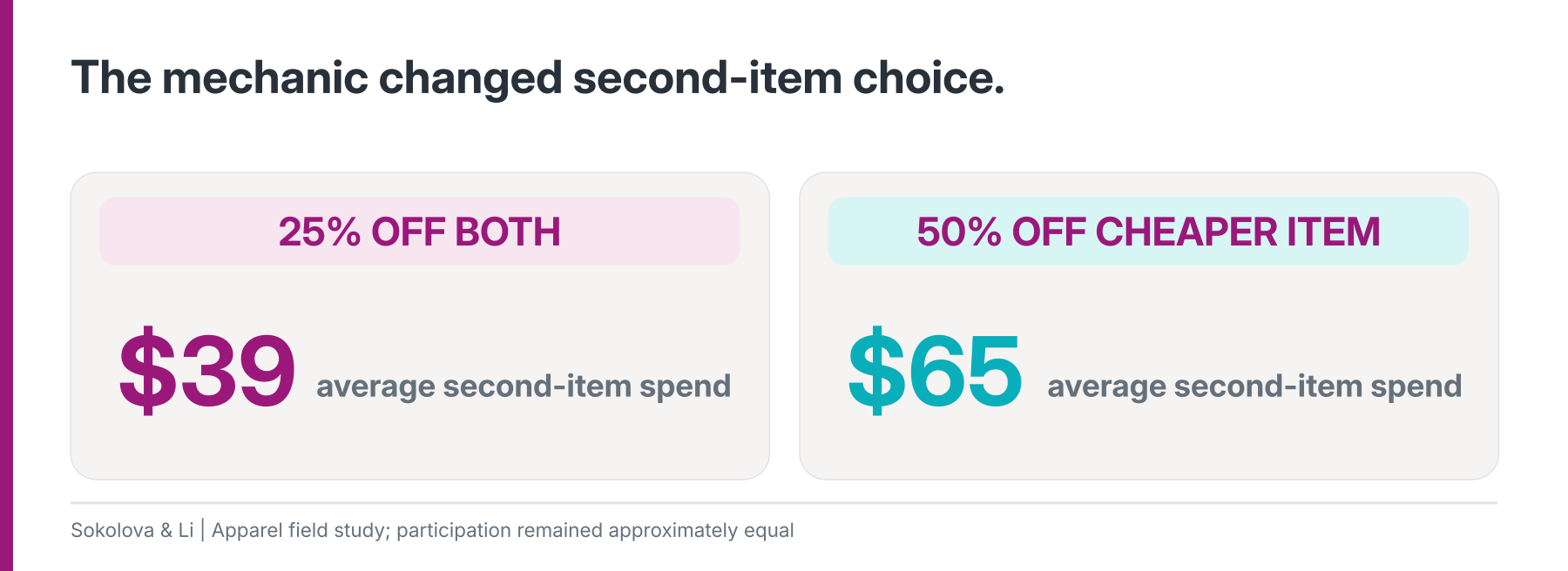
The study took place in apparel, yet the behavioral possibility is relevant to CPG promotions with multiple eligible products: changing the mechanic may change basket mix and value, not just participation or units.
3. The product group can change who wins
A promotion can influence a shopper's choice even when the shopper never earns the discount. Research on packaged-goods bundle promotions found that shoppers sometimes switched toward a participating product while buying too few units to qualify. The offer changed brand choice without ever appearing as a redeemed multi-buy transaction.
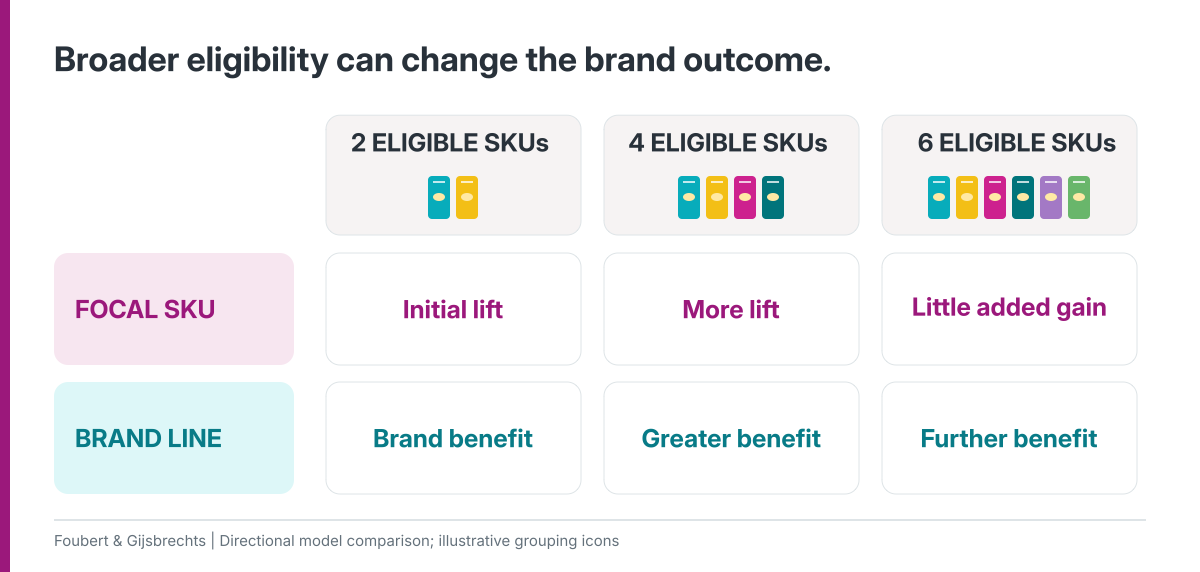
The same research found that the eligible group could change the balance between an individual SKU and the brand. In potato-chip simulations, expanding a PPG from two eligible SKUs to four improved modeled sales response for a focal SKU. Moving to six brought little further benefit for that product, but sales across the full brand line continued to rise as eligibility broadened.
The bigger opportunity may lie not just in how many products are included, but in which ones are included. Purdue researchers used more than 550,000 transaction records and 559,000 promotion records to model alternative PPG configurations for a consumer-products manufacturer. Their models suggested annual revenue improvements of 4.2% for home care, 4.0% for personal care, and 2.9% for oral care, amounting to about 3.5%, or $15.5 million, across the categories studied.
Existing PPGs aren't necessarily the most effective combinations. Two offers can use the same discount and the same number of eligible SKUs but perform differently because the products interact differently. That makes the PPG a strategic choice, not simply the last step in promotional setup.
4. The biggest lift isn't necessarily the best result
The story changes again when we look beyond the immediate promotional sales bump. Across four scanner datasets, researchers separated lift into brand switching, purchases pulled forward from future periods, and category expansion. Each accounted for roughly one-third on average, even though the headline lift figure would not reveal those different shopper behaviors.
Execution also shaped where the lift came from. In the retailer-flyer and in-store-display promotions studied, purchases pulled forward accounted for 39% of lift from flyer-only offers versus 15% from display-only offers. Category expansion accounted for 44% of lift from display-only promotions.
Those sources of sales matter to a manufacturer in different ways. Stock-up can shift purchases from a later period, competitor switching can bring sales into the brand, and a broader PPG can redistribute sales among the manufacturer's own SKUs. Even when two promotions deliver similar short-term lift, their results for portfolio unit sales, revenue, and profit may diverge.
5. The best promotion may be a combination you haven't tested
Taken together, the research doesn't identify one universally winning mechanic. It reveals a much wider set of choices: advertised quantities influence what shoppers consider; qualifying thresholds affect participation; discount framing and allocation affect attention and product choice; and PPG composition can change SKU and brand performance.
Those choices interact. A broader eligible group may make a higher threshold easier to meet, while a different discount structure may change which eligible products shoppers select. Extra units sold today may also reflect competitor switching or purchases brought forward from later periods. For manufacturers, the opportunity is to test combinations of mechanics, quantities, discounts, and product groupings, not simply choose between BOGO and a fixed-price offer or change the depth of a familiar discount.
At Astrea, we help manufacturers evaluate different promotion mechanics, discount depths, and PPG groupings to identify the promotional strategies best suited to their brands, whether the objective is to optimize unit sales, revenue, or profit.
The most effective promotion may not be the one with the most attention-grabbing offer. It may be a combination you haven't tested yet.
Research references
- Gravert, C., & Mormann, M. (2025). In-store food promotions increase sales as well as household food waste.
https://doi.org/10.1038/s41598-025-01800-x
- Wansink, B., Kent, R. J., & Hoch, S. J. (1998). An anchoring and adjustment model of purchase quantity decisions.
https://doi.org/10.1509/jmkr.35.1.71
- Manning, K. C., & Sprott, D. E. (2007). Multiple unit price promotions and their effects on quantity purchase intentions.
https://doi.org/10.1016/j.jretai.2007.03.011
- Drechsler, S., et al. (2017). Multi-unit price promotions and their impact on purchase decisions and sales.
https://doi.org/10.1108/EJM-12-2013-0729
- Foubert, B., & Gijsbrechts, E. (2007). Shopper response to bundle promotions for packaged goods.
https://doi.org/10.1509/jmkr.44.4.647
- Gordon-Hecker, T., et al. (2020). Buy-one-get-one-free deals attract more attention than percentage deals.
https://doi.org/10.1016/j.jbusres.2019.02.070
- Yang, H., & Chakravarti, D. (2024). The discount consolidation effect.
https://doi.org/10.1002/jcpy.1407
- Sokolova, T., & Li, Y. (2021). Mix or match? Consumer spending decisions in conditional promotions.
https://doi.org/10.1002/jcpy.1166
- Harisankar, S., et al. (2020). A holistic approach for determining effective promotional product groupings.
https://matthewalanham.com/Students/2020/ICDATA20_A%20Holistic%20Approach%20for%20Determining%20Effective%20Promotional%20Product%20Groupings.pdf
- van Heerde, H. J., Leeflang, P. S. H., & Wittink, D. R. (2004). Decomposing the sales promotion bump with store data.
https://doi.org/10.1287/mksc.1040.0061
